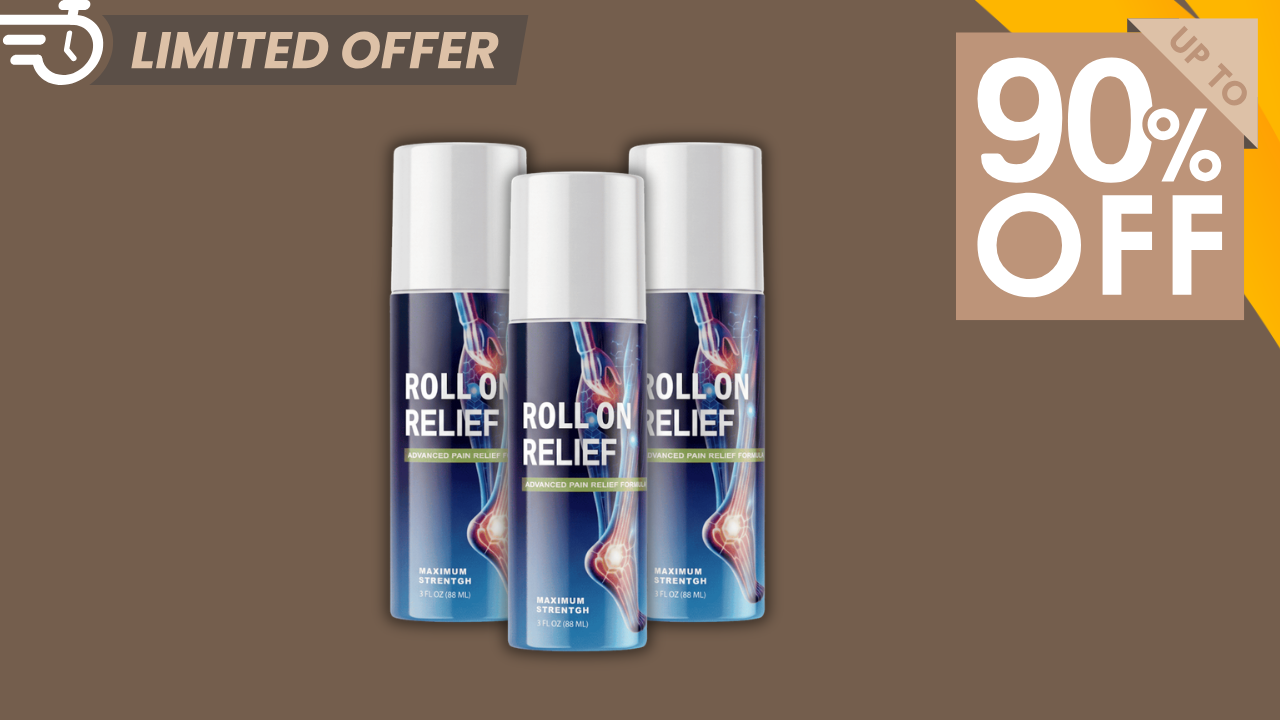
Roll On Relief Review
Roll On Relief Review: A Roll On Relief Review should answer one question first.
Can this topical product reasonably help temporary muscle soreness?
That question matters because skeptical buyers have heard every promise before.
They have already tried creams, sprays, gels, and cooling formulas.
They do not want another loud sales pitch.
They want ingredients, numbers, research, warnings, and realistic expectations.
The available evidence gives them something useful to examine.
However, it does not prove guaranteed relief within seven days.
That distinction makes this Roll On Relief Review more useful.
| Feature | Details |
|---|---|
| Product Name | Roll On Relief™ |
| Product Type | Topical analgesic roll-on |
| Bottle Size | 3 fl oz |
| Main Purpose | Temporary relief of minor muscle and joint aches |
| Active Ingredients | Camphor, menthol, peppermint oil |
| Camphor | 80 mg |
| Menthol | 50 mg |
| Peppermint Oil | 30 mg |
| Total Active Ingredients | 160 mg per serving |
| Application | Rolling-ball applicator |
| Listed Uses | Muscle aches, joint aches, backache, strains, sprains |
| Daily Directions | Apply no more than four times daily |
| Seven-Day Claim | No guaranteed seven-day result shown |
| Refund | 60-day money-back guarantee stated on product page |
| Main Buyer Concern | Whether evidence supports the formula and claims |
| Customer Reviews | No independent review data appears in supplied material |
| Key Safety Point | External use only; follow label warnings |
Can Roll On Relief help temporary muscle soreness?
Roll On Relief contains camphor, menthol, and peppermint oil.
These ingredients appear in topical products used for temporary discomfort.
Research also supports menthol-based topical analgesics for some pain conditions.
However, no evidence shown here guarantees Roll On Relief works within seven days.
That is the standard this Roll On Relief Review will use.
No miracles.
No invented customer stories.
No guaranteed timeline.
Just ten different evidence checks that help buyers judge the formula.
Roll On Relief Review: Is It A Recognized Topical Analgesic?
The first evidence line starts with the product category.
Roll On Relief describes itself as a topical analgesic.
That category matters.
External analgesics are products applied directly to the skin.
They aim to provide temporary relief in a specific area.
The supplied research notes that federal drug standards recognize external analgesics.
Those standards also cover ingredients such as camphor and menthol.
That gives this Roll On Relief Review an important starting point.
The formula does not rely on an unknown product category.
It uses ingredients already associated with topical analgesic products.
That does not prove Roll On Relief works for everyone.
It does show the basic product concept has an established foundation.
A skeptical buyer should care about that difference.
A product can use recognized ingredients and still produce different experiences.
That is why the next evidence line matters.
Roll On Relief Review: What Does Menthol Actually Do?
Menthol creates the cooling feeling many topical products use.
But cooling is not only about sensation.
The supplied research connects menthol with TRPM8 sensory receptors.
Those receptors help detect cooling signals.
Menthol activates those pathways when placed on the skin.
Researchers also describe menthol as a topical counterirritant.
That mechanism gives this Roll On Relief Review stronger context.
The ingredient has a known reason for appearing in topical formulas.
That matters more than a vague phrase like “advanced relief technology.”
Roll On Relief lists 50 mg of menthol per serving.
The product also lists that amount openly.
This is useful for comparison.
Buyers can see the ingredient instead of guessing about the formula.
That transparency does not guarantee better results.
But it makes the Roll On Relief Review easier to evaluate.
A skeptic can compare facts instead of trusting advertising language.
Roll On Relief Review: What Did Human Menthol Research Find?
Mechanisms explain what an ingredient may do.
Human testing asks whether people actually respond.
The supplied evidence describes one randomized menthol study.
Researchers tested sixteen participants.
They measured pain-pressure thresholds before and after topical application.
The study reported an overall increase of about 11.6%.
That meant participants tolerated more pressure before reporting pain.
This study did not test Roll On Relief.
That point must stay clear.
It tested another menthol-based topical analgesic.
Still, it gives this Roll On Relief Review relevant supporting evidence.
Roll On Relief contains menthol.
The research therefore supports the ingredient category, not this exact bottle.
That difference protects the buyer from a common review mistake.
Ingredient evidence should never become fake product-level proof.
A careful Roll On Relief Review keeps those claims separate.
Roll On Relief Review: What Does Muscle Soreness Research Show?
Muscle soreness gives us a more direct test.
The supplied material describes a 2012 study.
Researchers studied delayed onset muscle soreness after exercise.
Sixteen participants developed soreness under controlled conditions.
Researchers compared topical menthol treatment with ice.
The participants reported lower pain after the menthol treatment.
The study also measured muscle force.
The menthol condition showed stronger tetanic force than ice.
Again, Roll On Relief itself was not tested.
That matters.
However, this research directly involved exercise-related muscle soreness.
That makes it relevant to a Roll On Relief Review.
The evidence supports menthol-based topical treatment as a plausible option.
It does not prove every menthol roll-on performs identically.
Formulas differ.
Application amounts differ.
People also respond differently.
Still, this evidence comes from a different research method.
That gives the overall case another independent support point.
Roll On Relief Review: Can It Relieve Soreness Within Seven Days?
This is where buyers should become especially careful.
A seven-day promise sounds precise.
Precision can make a claim feel more believable.
But precise claims require precise evidence.
The supplied material describes a seven-day musculoskeletal pain study.
Researchers tested two menthol-based cream formulas.
Both groups showed improvement from baseline by Day Eight.
One combination formula performed better than menthol alone.
That finding gives this Roll On Relief Review useful context.
Topical menthol has been studied across a similar timeframe.
However, researchers did not test Roll On Relief in that study.
The formulas were different.
The study therefore cannot prove a seven-day Roll On Relief outcome.
This matters because the product warning uses seven days differently.
Users should seek medical advice when symptoms continue beyond seven days.
That is not a promised deadline for success.
It is a safety point.
Any Roll On Relief Review claiming guaranteed seven-day relief goes too far.
The evidence supports temporary soreness relief as plausible.
It does not support a guaranteed calendar result.
Roll On Relief Review: What Does Clinical Guidance Say?
Research papers are only one source of evidence.
Clinical guidance gives another viewpoint.
The supplied material cites Cleveland Clinic guidance on muscle pain.
That guidance discusses topical pain-relief products.
It also mentions ingredients such as menthol.
This gives the Roll On Relief Review another independent evidence line.
Clinical guidance does not exist to sell Roll On Relief.
It addresses muscle discomfort more broadly.
That independence matters to skeptical buyers.
A sales page has a reason to highlight benefits.
Clinical education serves a different purpose.
Yet both point toward topical products for localized discomfort.
That does not prove the Roll On Relief formula will work.
It does strengthen the broader treatment logic.
Topical relief is not an invented category created for this product.
Roll On Relief Review: Why Does Camphor Matter?
Menthol is not the only active ingredient listed.
Roll On Relief also contains 80 mg of camphor.
The supplied material notes camphor appears in topical pain products.
It also cites clinical information about camphor and menthol products.
These products are used for minor muscle and joint discomfort.
They can create cooling or warming sensations.
This adds another layer to the Roll On Relief Review.
The formula does not depend on menthol alone.
It combines menthol with another established topical ingredient.
Again, that does not create guaranteed results.
But it strengthens the reason behind the formula design.
The product also contains 30 mg of peppermint oil.
Together, the three listed actives total 160 mg per serving.
Numbers matter here.
They give buyers something concrete to inspect.
Roll On Relief Review: Does Ingredient Transparency Build Trust?
Skeptical buyers often dislike hidden blends.
They want exact ingredient information.
Roll On Relief lists its three active ingredients clearly.
The stated amounts are:
- Camphor: 80 mg
- Menthol: 50 mg
- Peppermint oil: 30 mg
- Total active ingredients: 160 mg per serving
The product also lists other ingredients.
Those include aloe vera gel and MCT oil.
It also lists tea tree oil and sunflower lecithin.
DMSO, arnica, turmeric, and ginger oil also appear.
This transparency strengthens the Roll On Relief Review.
It does not prove the formula works better.
Transparency and effectiveness are different questions.
But clear amounts help buyers compare competing products.
That builds trust because fewer details remain hidden.
A product cannot earn credibility through numbers alone.
Still, numbers make exaggerated claims easier to challenge.
That is useful for any serious Roll On Relief Review.
Roll On Relief Review: Does The Roll-On Design Matter?
Ingredients explain only part of the product experience.
Application also matters.
Traditional creams usually require direct hand contact.
You squeeze the cream onto your fingers.
Then you spread it over the sore area.
Afterward, you may need to wash your hands.
Roll On Relief uses a rolling-ball applicator.
The formula goes directly onto the target area.
That design gives the Roll On Relief Review a practical advantage.
The product may feel simpler to use during everyday routines.
The sales material also highlights hard-to-reach areas.
The middle of the back provides a clear example.
A longer bottle with a rolling applicator may help there.
This feature does not make the ingredients stronger.
It does not improve the pharmacology.
It simply makes application easier.
That distinction matters.
Convenience can affect whether someone uses a product consistently.
A bottle left untouched cannot provide temporary comfort.
Roll On Relief Review: Do The Safety Rules Make Sense?
Strong reviews should examine warnings too.
Positive claims alone do not build trust.
Roll On Relief includes several clear safety directions.
The supplied material says users should avoid damaged skin.
Users should also avoid eye contact.
The product should not be combined with heating pads.
Application should stay within the listed daily limit.
Adults and children over 12 can apply it up to four times daily.
These details strengthen this Roll On Relief Review.
They show that topical analgesics require responsible use.
More product does not automatically mean more relief.
Following the label matters.
The product information also warns about persistent symptoms.
Users should contact a doctor when symptoms continue beyond seven days.
That warning deserves attention.
Persistent pain can have causes that need proper medical assessment.
A good Roll On Relief Review should never hide that point.
Roll On Relief Review: What Do These Ten Evidence Checks Show?
These ten checks do not come from one type of information.
That is their strongest feature.
The evidence includes:
- External analgesic drug standards.
- Menthol receptor research.
- Randomized human testing.
- Exercise soreness research.
- Seven-day musculoskeletal research.
- Clinical muscle-pain guidance.
- Camphor ingredient information.
- Exact product formula details.
- Roll-on application design.
- Safety and usage instructions.
These sources answer different questions.
Drug standards explain recognized product categories.
Pharmacology explains possible mechanisms.
Human studies test measurable responses.
Sports research examines soreness after exercise.
Clinical guidance addresses real-world treatment choices.
Product details explain what Roll On Relief contains.
Safety instructions explain proper use.
That makes this Roll On Relief Review stronger than one testimonial.
However, the evidence does not all prove the exact same thing.
That point matters.
The studies did not independently test Roll On Relief itself.
They mainly support its ingredients and topical treatment approach.
Calling that product-level proof would stretch the evidence.
A credible Roll On Relief Review should not make that leap.
Roll On Relief Review: What Complaints Should Buyers Consider?
The word “complaints” often attracts serious buyers.
They want to know what could go wrong.
The supplied material does not provide verified customer complaint data.
That means we should not invent positive or negative reviews.
Still, several reasonable buyer concerns emerge from the product details.
Some buyers may dislike strong cooling sensations.
Others may prefer creams instead of roll-on products.
Some people may expect faster relief than the formula provides.
Others may assume “maximum strength” guarantees dramatic results.
That expectation can cause disappointment.
This Roll On Relief Review takes a simpler position.
Judge the product by its stated use.
It is designed for temporary relief of minor aches and pains.
It is not presented as a cure for muscle injuries.
It also does not guarantee seven-day results.
That realistic standard matters more than anonymous hype.
Roll On Relief Review: What Can Skeptical Buyers Actually Trust?
Skeptical buyers often trust measurable details.
Roll On Relief gives them several.
The bottle contains 3 fl oz.
The formula lists 160 mg of active ingredients per serving.
Camphor accounts for 80 mg.
Menthol accounts for 50 mg.
Peppermint oil accounts for 30 mg.
The instructions limit daily application.
The product page also states a 60-day money-back guarantee.
These numbers give this Roll On Relief Review useful anchors.
They are more useful than phrases like “life-changing relief.”
Independent research also gives the ingredients scientific context.
That combination builds a reasonable case.
It does not build a guarantee.
Roll On Relief Review: Is Roll On Relief Legitimate Or Just Hype?
Calling any health product “100% proven” would be careless here.
The evidence does not support that statement.
But calling the formula empty hype would also ignore key facts.
Roll On Relief contains recognized topical analgesic ingredients.
Menthol has documented sensory effects.
Human research supports menthol-based topical analgesics.
Camphor also appears in topical pain products.
The product clearly lists active ingredient amounts.
Its roll-on design also solves a simple application problem.
That gives this Roll On Relief Review a grounded conclusion.
There is a credible reason someone may consider this product.
The strongest case rests on temporary relief.
It does not rest on miracle claims.
Roll On Relief Review: The Seven-Day Question Needs One Final Answer
Seven days sounds attractive because it feels measurable.
But a search phrase cannot create clinical evidence.
No supplied evidence proves Roll On Relief guarantees relief within seven days.
A different menthol study used a similar timeframe.
That research provides context, not product-specific proof.
The product warning also mentions seven days.
It tells users to seek help when symptoms continue.
This distinction should guide every Roll On Relief Review.
A seven-day period can help someone reassess their symptoms.
It should not become a made-up guarantee.
That is the difference between useful content and sales hype.
Roll On Relief Review: The Evidence-Based Buyer Verdict
The evidence lands in a practical place.
Roll On Relief has a credible basis for temporary soreness relief.
Its active ingredients fit recognized topical analgesic use.
Menthol research gives the formula a clear scientific foundation.
Camphor adds another established topical ingredient.
The roll-on design also makes targeted application simple.
This Roll On Relief Review does not need exaggerated claims.
The product already gives buyers enough concrete facts to examine.
What it cannot give is guaranteed seven-day relief.
Nobody should turn supporting ingredient research into that promise.
If temporary muscle soreness is your concern, judge the actual formula.
Check the ingredients, warnings, directions, and your own needs.
That is the standard worth using.
Read the full label before you decide whether to buy.
Frequently Asked Questions About Roll On Relief Review
What is Roll On Relief used for?
Roll On Relief is a topical analgesic.
Its stated purpose is temporary relief of minor aches.
The page mentions muscle aches, joint discomfort, backache, strains, and sprains.
Does Roll On Relief work within seven days?
The supplied page does not guarantee relief within seven days.
Its seven-day statement appears inside the product warning.
Users should seek medical advice when symptoms continue beyond seven days.
What active ingredients does Roll On Relief contain?
Roll On Relief lists three active ingredients.
They are camphor, menthol, and peppermint oil.
The listed total equals 160 mg per serving.
How much does Roll On Relief cost?
One bottle costs $39 on the supplied page.
Three bottles cost $68 total.
Six bottles cost $116 and include free shipping.
Does Roll On Relief offer a money-back guarantee?
Yes.
The supplied page states a 60-day money-back guarantee.
Buyers should read the full refund terms before ordering.
Roll On Relief Reviews And Complaints 2026 USA: Facts Buyers Should Know Before Ordering